
A planning guide, not an event listing. No meetings or visits are scheduled by this site. Confirm current dates and attendance with the actual organizer.
A six-week backward plan
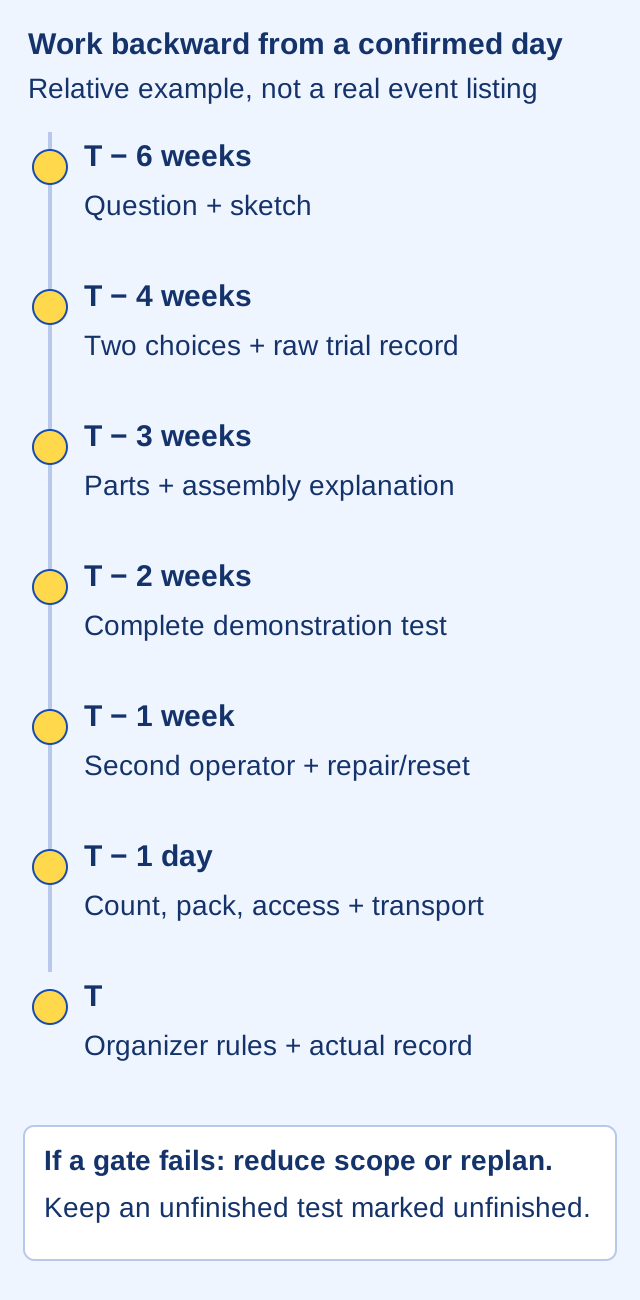
Example only: a small demonstration project working toward organizer-confirmed day T. This is not a published team season or an event schedule. Add real dates after the organizer confirms them.
- T − 6 weeks: choose one visible task, list constraints and agree the measurement. Exit check: a sketch and test question.
- T − 4 weeks: compare two mechanism choices. Exit check: labelled setup and raw trial record; unresolved problems have owners.
- T − 3 weeks: choose a version and document parts and assembly. Exit check: a second person can explain the build.
- T − 2 weeks: run the complete demonstration from start to finish. Exit check: the actual sequence works under the intended conditions; reserve time for faults.
- T − 1 week: practise operation, repair and reset; freeze optional additions. Exit check: a second operator can repeat the task using the record.
- T − 1 day: pack and count parts, tools and documents; confirm access and transport. Exit check: checklist signed by the responsible organizer.
- T: use the organizer’s check-in and safety rules. Record what actually happened and review it afterward.
If a gate fails, reduce the demonstration’s scope or change the plan. Do not relabel an incomplete test as complete to protect the timetable.
Give each meeting an outcome
Before a session, choose one result that can be checked at the end: a measured prototype, a reviewed wiring plan or a tested software change. List the tools and people needed. Close with a short record of what changed and what remains unresolved.
A filled 60-minute meeting plan
Illustrative agenda for the cup-lifter comparison; no meeting is claimed.
- 0–5: read the previous record; assign builder, observer and note keeper.
- 5–15: check support stability, arm marks and level start. Stop if the setup is not ready.
- 15–30: make and record three A trials.
- 30–45: switch pivot, rotate roles and make three B trials with unchanged load and input travel.
- 45–55: compare raw readings with predictions; write one supported conclusion and one open question.
- 55–60: remove load, count parts and assign the next check.
Required output: labelled sketch, six trial entries or explicitly marked unfinished entries, and a next action. The group record example shows the handoff.
Use a repeatable meeting agenda
Begin with a brief check-in and task allocation. Set aside a build period, a test period and time to put tools away. Assign the next action before everyone leaves so the next meeting can start from the written record.
Check dates at the source
This page contains a planning framework, not a live team calendar. For competition dates, venues and entry requirements, use the current organizer’s event pages. Older schedules should never be treated as permission to visit a workshop.
Use FIRST’s official team and event search to start a current-date check. A listing is not permission to attend a private meeting.
Historical references
These dated records concern the earlier team website. They do not describe the current operator.
- The April 2026 root navigation labels /about-6 as Parents and /calender as Calendar. Wix page metadata names /groups Groups. View sourceCapture 2026-04-22
- The saved homepages link outreach, sponsors, donation, calendar, contact, about and gallery routes; /memes appears as an unlabeled icon link. View sourceCaptures 2022-12-02 and 2026-04-22