
Build sheet: a two-position cup lifter
Status: proposed build, not assembled or tested by this edition. The design question is whether one small arm can show both a larger output movement and an easier ideal lift by changing its pivot. It uses the 320 mm cardboard arm from the first-session guide; no photograph on this site is evidence of this build.
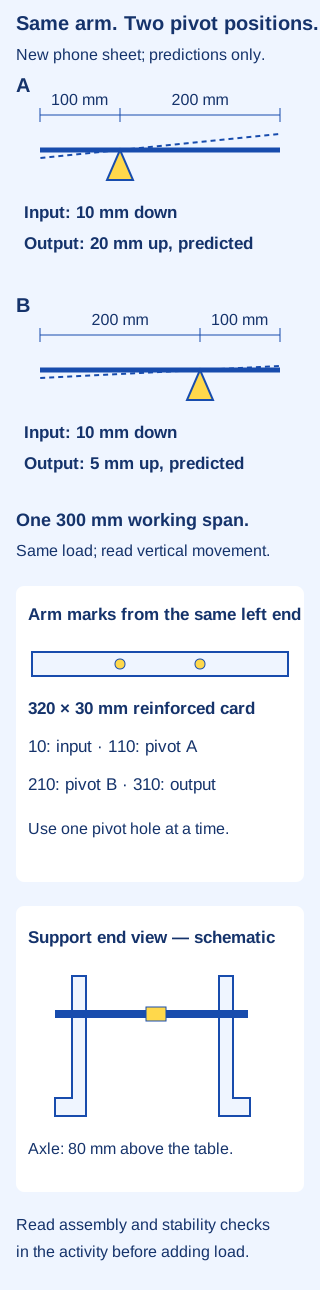
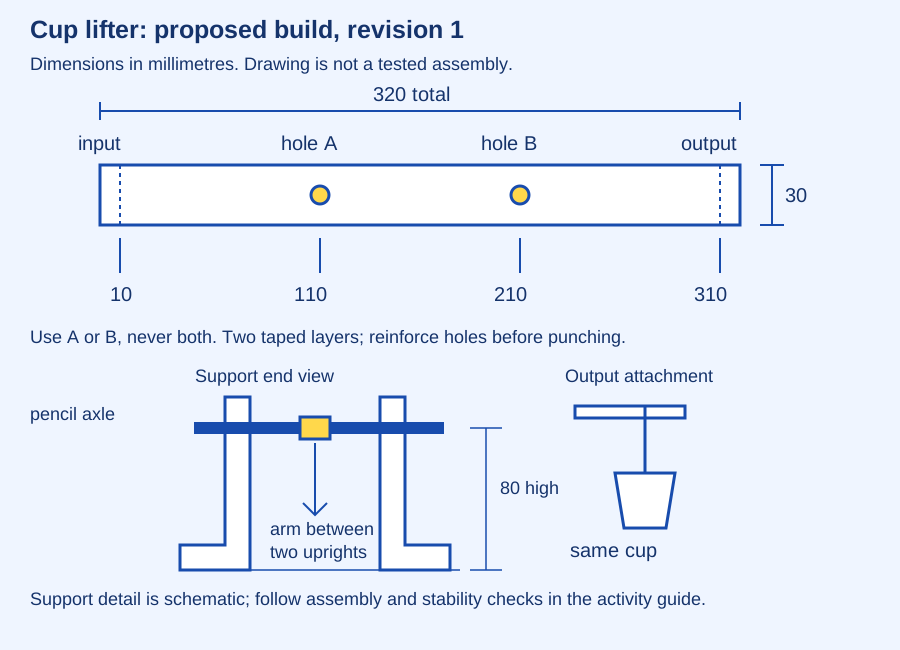
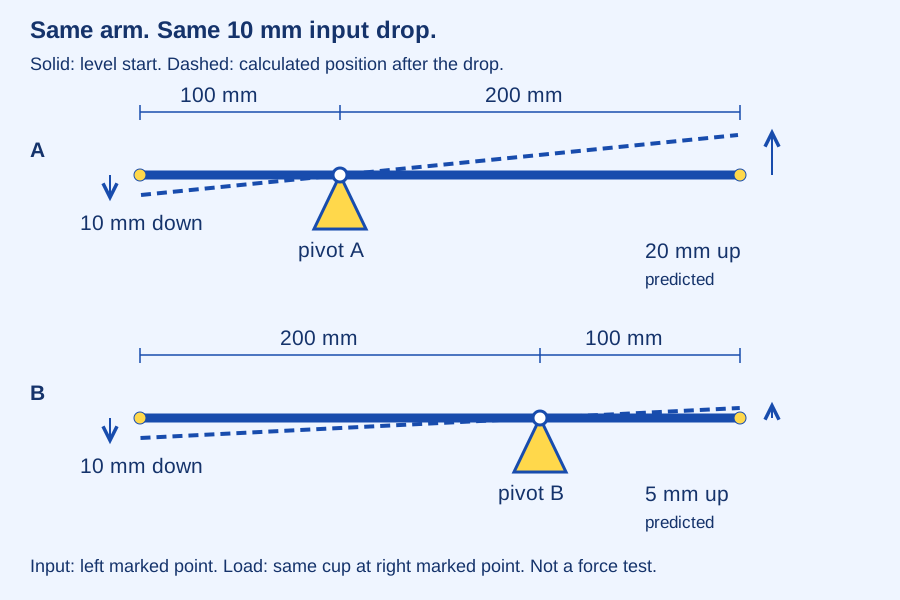
The dimensioned drawing identifies the two axle holes, the input mark, the cup attachment and the support. The total working span stays 300 mm. Switching holes changes the arms from 100:200 mm to 200:100 mm; cutting two arms of different lengths would spoil that comparison.
What each part is meant to do
- Reinforced arm, 320 × 30 mm
- Two taped card layers reduce bending. Marks at 10 and 310 mm define the same input and output points for both trials.
- Pivot A / B, at 110 / 210 mm
- A pencil through one hole is the axle. Only one hole is used at a time. The hole not in use must not carry another support.
- Two upright supports
- Folded feet are taped to the table. Matching axle holes are 80 mm high. The pencil passes through both uprights with the arm between them.
- Cup and two light washers
- Thread ties the same small load at the output mark. Neither the cup mass nor the washers are changed between A and B.
- Two rulers
- One controls the 10 mm vertical input drop; the other measures output rise. No component here measures force.
Materials, hole preparation and assembly sequence are listed in the activity guide. Check stability before adding the load; this drawing is a construction plan, not a safety certification.
The planned test and the decision it can support
Run three A trials and three B trials, returning to a horizontal arm before each trial. Keep the same 10 mm input drop and record actual output rise. The geometric predictions are 20 mm at A and 5 mm at B. No measured results are filled in yet.
If a later task needs more travel from the same input movement, A is the first candidate. If it needs less input force for the same load, B is the ideal lever candidate, but that claim needs a separate force measurement. Do not conclude that the greater-travel version is stronger.
A possible revision is an extra card layer if the output end bends. That is a proposed change, not a completed improvement. If used, apply the same reinforcement to both pivot trials, write down the new thickness, and repeat the complete comparison. Moving the pivot and stiffening the arm at the same time would leave the cause unclear.
A publishable project record
Example record before building
Question: output rise for 10 mm input drop.
Drawing revision: cup lifter 1, dimensions shown above.
Prediction: A 20 mm; B 5 mm.
Observed result: not measured.
Unresolved: axle friction, arm stiffness and support stability.
Next action: assemble, check the unloaded motion, then follow the six-trial record.
After an actual test, add the date, setup photograph or sketch, raw readings and any revision. Obtain permission before publishing people’s images. Record a failed or incomplete test as such; keep the prediction beside the observation rather than replacing it.
More project prompts: inspectable wiring
This is a prompt, not a circuit build sheet. Choose one low-voltage controller and sensor only after obtaining their current manufacturer documentation. Draw the supply, ground and signal connections with actual pin names and stated ratings. Have the organizer review the diagram before energizing anything. The decorative board illustration is not a wiring reference.
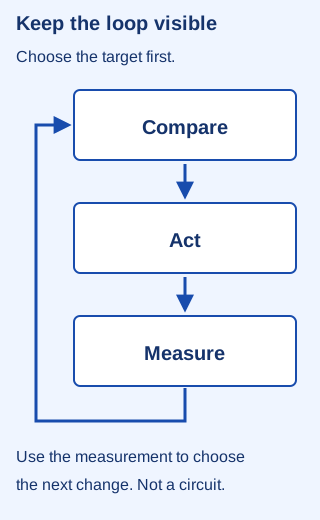
Keep the control-system question separate from the wiring: choose a target, act, measure and compare the result. A loop diagram explains that information flow; it does not establish an electrical connection or prove a program works.
More project prompts: make a test repeatable
Sketch the starting position and mark the measurement points. Ask a second person to repeat the written setup before offering extra verbal instructions. Record what they had to ask; those gaps tell you what to add to the build sheet.
These project prompts and diagrams are new material. Former students’ photographs and the earlier site’s gallery have not been recovered or reproduced.