
The question and the comparison
Which pivot position raises the same small load farther when the input point moves down by 10 mm? This activity compares displacement. It does not hold the applied force constant or measure mechanical efficiency.
Use the same arm, cup and two washers for both positions. Change only the pivot hole. Start the arm level, move slowly and record three trials at each position. This is a proposed activity; no physical trial by this edition is reported.
Materials and preparation
For one group: two stiff corrugated-card strips, each 320 × 30 mm; tape; two cereal-box card pieces, each 140 × 100 mm; one straight unsharpened pencil about 7 mm in diameter; a small paper cup; cotton thread; two identical light washers; two millimetre rulers; and a pencil for recording.
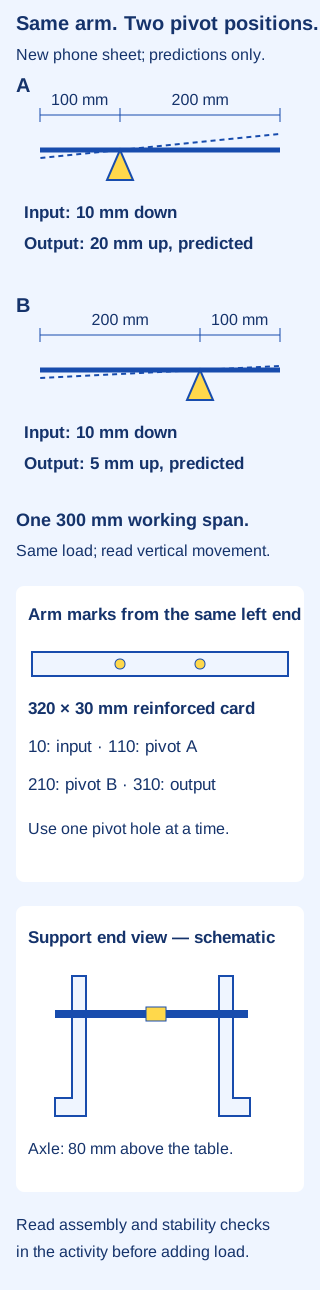
An adult prepares the cuts and approximately 8 mm axle holes with a suitable punch. Tape the two long strips together to make one stiff arm. Mark the input point 10 mm from its left end, pivot A at 110 mm, pivot B at 210 mm, and the output point at 310 mm. Reinforce both pivot holes with tape before punching. Measure from the same end every time.
Fold a 40 mm foot along the bottom of each 140 mm support, leaving a 100 mm upright. Punch one axle hole 80 mm above the tabletop in each upright. Set the uprights parallel, about 15 mm apart, tape their feet firmly to the table, and pass the pencil through support–arm–support at pivot A. The arm must rotate freely without sliding along the pencil. Add loose tape collars outside the supports; do not clamp the arm.
Tie the cup under the output mark with a short thread and tape the knot in place. Put the two washers in the cup. Use only this small tabletop load; keep hands and faces away from the moving ends. Check that the feet stay attached, the axle cannot roll out and the cup clears the table. Stop if the arm bends, catches or the support lifts. The host chooses supervision and materials suitable for its participants.
Run one controlled trial
- Place a vertical ruler next to the input mark and another next to the output mark. Read the arm marks, not the swinging cup rim. Keep rulers clear of the arm.
- Hold the input gently until the loaded arm is horizontal. Record each mark’s starting height. The axle is 80 mm above the table; verify the level position rather than assuming it.
- Lower the input mark by exactly 10 mm, using its ruler as a reference. Do not push it along a guide or give it a flick. Stop and hold; read the output mark’s upward change.
- Record the input and output changes. Return to the level start and repeat twice. Note slipping, bending, friction or a difficult reading instead of hiding a poor trial.
- Remove the cup briefly, move the same arm to pivot B and rehang the same cup at the same output mark. Keep the support, load, rulers and 10 mm input travel unchanged. Repeat three trials.
The input end also moves slightly sideways as it rotates. Measure the change in vertical height of its marked point; do not measure the finger’s path or the arc length.
Expected from geometry; not measured
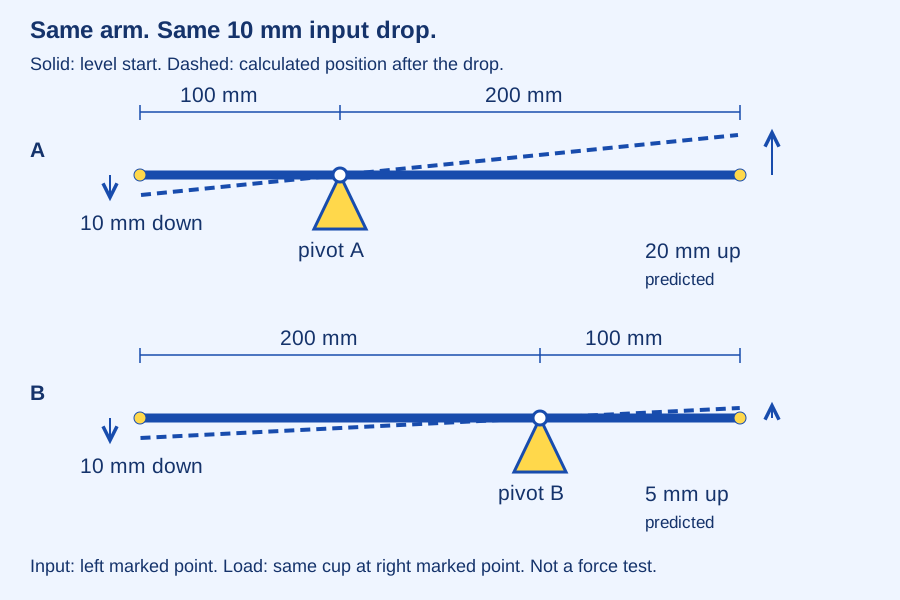
At A, the input arm is 100 mm and the output arm is 200 mm. At B, those lengths are 200 mm and 100 mm. For a rigid arm rotating from horizontal, both vertical changes contain the same sine of the rotation angle. Therefore output rise / input drop = output arm / input arm.
- A: 10 mm × 200 / 100 = 20 mm expected rise.
- B: 10 mm × 100 / 200 = 5 mm expected rise.
These are calculated predictions for the marked points, not published results. A flexible card arm, a loose pivot or reading error can make a real observation differ. Record the actual displacement before deciding whether the model fits.
Force is a different comparison. In an ideal massless, frictionless lever at balance, input force × input arm = load force × output arm. A would need twice the load force; B half the load force. The cardboard’s own weight and pivot friction affect a real force measurement. This activity has no force gauge and does not verify those force values.
NASA’s lever lesson explains the trade between effort and distance. The numerical predictions here follow the dimensions in this guide; NASA did not test this proposed build.
A record to take away
Copy this sheet or download the blank CSV record. Enter observations only after a trial. Keep predictions in their own column.
| Pivot / trial | Input drop, mm | Predicted rise, mm | Measured rise, mm | Setup notes |
|---|---|---|---|---|
| A / 1 | ____ | 20 at 10 mm input | ____ | ____ |
| A / 2 | ____ | 20 at 10 mm input | ____ | ____ |
| A / 3 | ____ | 20 at 10 mm input | ____ | ____ |
| B / 1 | ____ | 5 at 10 mm input | ____ | ____ |
| B / 2 | ____ | 5 at 10 mm input | ____ | ____ |
| B / 3 | ____ | 5 at 10 mm input | ____ | ____ |
Also record the date, actual arm dimensions, cup and washer description, axle height, and any changed condition. Finish with one sketch, one comparison supported by your readings, and one question for a second attempt.
A 45-minute session
This timetable assumes an adult has cut the parts and punched the holes before the session.
- 5 minutes: introduce displacement versus force, check parts and choose roles.
- 10 minutes: assemble and check free rotation and stability.
- 10 minutes: make three A trials and write the readings.
- 10 minutes: change to B and make three more trials.
- 5 minutes: compare measurements with the predictions and explain one source of error.
- 5 minutes: remove the load, count parts and clean up.
Make participation easy
Offer drawing, building, measuring and recording roles without assuming programming or workshop experience. Rotate roles between pivot positions, with the same measurement method explained to the next observer. If time runs out, keep the partial record and label unfinished trials; a complete-looking table is not the goal.
This is new learning material, not a report of an event run by Archytas Education Corp or FRC team 6933.